Supreme Court Section 21 Appeal 2026: Muca v El Amrani – Court Grants Landmark Section 21 Appeal – But Has the Decision Come Too Late for Landlords?
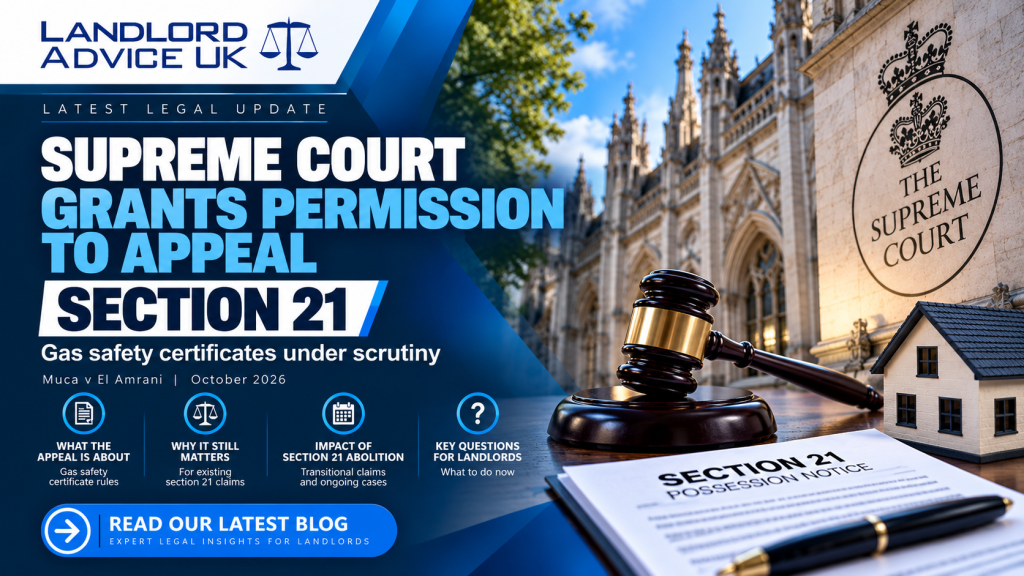
Muca v El Amrani [2026] EWCA Civ 515: Supreme Court to reconsider whether failing to provide a gas safety certificate before a tenant moves in permanently invalidates a Section 21 notice.
In a potentially significant development for landlords across England, the Supreme Court has granted permission to appeal in Muca v El Amrani, a case concerning one of the most contentious aspects of Section 21 possession proceedings: the failure to provide a gas safety certificate before a tenant first occupies a property.
On 6 October 2026, the Supreme Court granted the landlord permission to challenge the Court of Appeal’s decision, which held that failure to provide the relevant pre-occupation gas safety certificate was fatal to the validity of a subsequent Section 21 notice.
The decision to grant permission is significant. However, its timing raises an obvious question.
Has this potentially landmark appeal arrived too late to make any meaningful difference to landlords?
After all, Section 21 of the Housing Act 1988 was abolished for private rented sector tenancies in England on 1 May 2026, following the implementation of the Renters’ Rights Act 2025.
Yet the answer is not quite so straightforward.
Although landlords can no longer commence new Section 21 possession proceedings, claims validly commenced before the transitional deadline can continue through the courts.
For those landlords whose existing possession claims are being defended on the grounds of alleged gas safety non-compliance, the Supreme Court’s eventual judgment could prove decisive.
What Is Muca v El Amrani About?
The dispute concerns whether a landlord who failed to provide a gas safety certificate before the tenant first occupied the property can subsequently rely upon Section 21, notwithstanding that gas safety certificates were provided in later years.
The background to the case is particularly important.
On 5 February 2014, Mr Maksim Muca granted Ms Rachida Rechia El Amrani an assured shorthold tenancy of a residential property in Essex for a fixed term of 12 months.
When that tenancy expired, a statutory periodic tenancy arose.
In February 2017, the parties entered into a further six-month fixed-term tenancy, following which another statutory periodic tenancy arose.
The landlord had not provided the tenant with a gas safety certificate before she first occupied the property in 2014.
However, annual gas safety certificates were subsequently issued between 2015 and 2024, with copies supplied to the tenant in January 2025.
On 28 January 2025, the landlord served a Section 21 notice seeking possession.
When the tenant failed to vacate, possession proceedings were commenced in May 2025.
The tenant defended the claim, arguing that the landlord’s original failure to provide a gas safety certificate before occupation prevented him from serving a valid Section 21 notice.
This argument ultimately succeeded before the Court of Appeal.
How Did the Case Reach the Supreme Court?
The procedural history demonstrates how differently the courts have approached the gas safety requirements.
First Instance – County Court
Deputy District Judge Goodchild struck out the landlord’s possession claim, concluding that the gas safety requirements had not been satisfied.
First Appeal – Circuit Judge
The landlord appealed.
In December 2025, His Honour Judge Roberts allowed the appeal and made a possession order in favour of the landlord.
Court of Appeal – April 2026
The tenant appealed again.
On 30 April 2026, the Court of Appeal allowed the tenant’s appeal, restoring the original decision against the landlord.
The Court of Appeal held that the failure to provide the relevant pre-occupation gas safety certificate was fatal to the Section 21 notice, despite the subsequent provision of gas safety records.
Supreme Court – October 2026
On 6 October 2026, the Supreme Court granted the landlord permission to appeal.
The Supreme Court will now have the opportunity to consider whether the Court of Appeal’s interpretation of the legislation was correct.
Crucially, permission to appeal does not mean that the Supreme Court has overturned the Court of Appeal’s decision. The existing judgment remains authoritative unless and until it is overturned.
Why Is the Gas Safety Certificate Issue So Important?
Before its abolition, Section 21 allowed landlords of assured shorthold tenancies to recover possession without establishing one of the statutory grounds for possession under Section 8.
However, that right was subject to strict statutory requirements.
Section 21A of the Housing Act 1988 prevented a landlord from serving a Section 21 notice while in breach of certain prescribed requirements.
Those requirements included obligations relating to gas safety documentation under the Assured Shorthold Tenancy Notices and Prescribed Requirements (England) Regulations 2015, read alongside the Gas Safety (Installation and Use) Regulations 1998.
Regulation 36(6)(b) of the 1998 Regulations required the relevant gas safety record to be provided to a new tenant before occupation.
The legal controversy concerns the consequences of failing to comply with that requirement.
Is the failure permanently fatal to the landlord’s ability to serve a Section 21 notice?
Or can the position be remedied through subsequent compliance?
The distinction is fundamental.
If the failure is permanently fatal, a landlord who omitted to provide a gas safety record at the outset could be prevented from relying upon Section 21 years later, even where annual inspections had subsequently been undertaken and records provided.
If the failure is capable of being remedied, subsequent provision of the appropriate records may permit a valid Section 21 notice to be served.
What Did the Court of Appeal Decide?
In Muca v El Amrani [2026] EWCA Civ 515, the Court of Appeal considered whether Section 21A prevented a landlord from serving a valid Section 21 notice where the tenant had not received the gas safety record relating to the inspection undertaken before first occupation.
The Court considered this question in circumstances where:
The tenant had received later gas safety certificates.
The original tenancy began before Section 21A came into force.
The tenant subsequently occupied the property under a different tenancy.
The Court concluded that the failure to provide the relevant pre-occupation gas safety record prevented the landlords from relying upon Section 21.
The decision also dealt with the related appeal in Harker v Hubert, which raised substantially the same legal issue.
For landlords, the consequences were potentially severe.
A failure to provide a document at the beginning of a tenancy could undermine a possession claim brought many years later, notwithstanding subsequent compliance with annual gas safety requirements.
The Court of Appeal recognised that the consequences of its interpretation could appear surprising, but nevertheless considered that the statutory wording required that result.
But Didn’t the Court of Appeal Previously Decide That Late Gas Safety Certificates Could Be Accepted?
Yes, and this is where the legal position becomes particularly interesting.
In Trecarrell House Ltd v Rouncefield [2020] EWCA Civ 760, the Court of Appeal considered whether a landlord’s failure to provide a gas safety certificate before occupation could be remedied by providing it subsequently.
The Court held, in substance, that late provision of the relevant existing gas safety record could satisfy the prescribed requirement for Section 21 purposes, provided it was supplied before the Section 21 notice was served.
That decision was widely regarded as favourable to landlords.
However, the distinction in Muca v El Amrani is critical.
In Trecarrell House, a relevant gas safety record existed before the tenant occupied the property but had not been provided at the required time.
The later provision of that record could remedy the omission.
In Muca v El Amrani, the issue concerned the absence of the relevant pre-occupation record from the documents provided to the tenant, notwithstanding the later supply of annual certificates.
The Court of Appeal distinguished the circumstances and concluded that subsequent gas safety records did not overcome the failure to provide the record relating to the period before the tenant first occupied.
The Supreme Court appeal therefore presents an opportunity to examine the interaction between these authorities and the correct interpretation of the statutory requirements.
The distinction landlords must understand
There is an important difference between:
Scenario A: A valid gas safety record existed before the tenancy began, but the landlord failed to provide it until after occupation.
Scenario B: The landlord cannot establish that the required pre-occupation gas safety record was provided, and instead relies upon certificates relating to inspections undertaken in subsequent years.
The legal consequences of these scenarios should not automatically be treated as identical.
A further distinction arises between failing to provide a certificate and failing to carry out the underlying gas safety inspection.
Those are separate factual and legal questions.
The Supreme Court’s eventual judgment may provide much-needed clarification.
Has the Supreme Court Appeal Come Too Late Following the Abolition of Section 21?
There is a considerable irony in the timing of this appeal.
The Court of Appeal delivered its judgment on 30 April 2026.
Just one day later, on 1 May 2026, Section 21 was abolished for private rented sector tenancies in England.
The Supreme Court has now granted permission to appeal in October 2026, approximately five months after the abolition took effect.
By the time the Supreme Court delivers its judgment, Section 21 may have been absent from the ordinary private rented sector possession regime for a substantial period.
For landlords entering new tenancies or seeking possession under the new system, the judgment will have limited direct practical relevance.
However, that does not mean the appeal is academic.
There remains an important category of landlords for whom the judgment could determine whether an existing possession claim succeeds or fails.
These are landlords whose Section 21 possession proceedings were commenced within the permitted transitional period and remain before the courts.
Can Landlords Still Rely on Section 21 Notices After 1 May 2026?
The Renters’ Rights Act 2025 abolished Section 21 for private rented sector tenancies in England from 1 May 2026.
However, transitional provisions were introduced to protect certain existing notices and possession proceedings.
Under Schedule 6 to the Act, the previous Section 21 regime continues to apply in defined circumstances.
Broadly, landlords who served a valid Section 21 notice before 1 May 2026 were permitted to commence possession proceedings within the applicable transitional period.
That period has now expired.
For most affected private sector tenancies, the final deadline was 31 July 2026, although an earlier deadline could apply depending upon the notice and the statutory time limits.
Consequently, landlords can no longer commence fresh Section 21 proceedings.
However, where proceedings were validly commenced within the relevant period, those proceedings may continue to their conclusion.
This distinction is essential.
The abolition of Section 21 did not automatically invalidate every possession claim already before the courts.
Existing proceedings may continue, and landlords may still be required to establish that the original Section 21 notice was valid when served.
That is precisely why the Supreme Court appeal remains relevant.
What Does the Supreme Court Appeal Mean for Landlords With Existing Section 21 Claims?
Landlords currently facing a defence based upon alleged gas safety non-compliance should pay particular attention to this appeal.
A tenant may argue that the landlord’s Section 21 notice was invalid because a gas safety certificate was not provided before the tenant originally occupied the property.
In some cases, the tenancy may have commenced many years before the possession proceedings were issued.
The landlord may have subsequently complied with annual gas safety inspections, supplied numerous certificates and entered into replacement tenancy agreements.
Nevertheless, the tenant may contend that the original omission permanently prevented the landlord from relying upon Section 21.
Depending upon the circumstances, the Supreme Court’s eventual judgment could materially affect the outcome.
Should landlords ask the court to adjourn existing possession proceedings?
Where an existing Section 21 possession claim turns upon the same legal issue, landlords may wish to consider whether an application to stay or adjourn proceedings pending the Supreme Court’s judgment would be appropriate.
However, such an application will not necessarily be granted.
The court will consider the particular circumstances, including the relevance of the appeal, potential prejudice to the parties, the likely delay and the overriding objective.
It is also important to recognise that the Court of Appeal’s judgment remains binding upon lower courts unless and until overturned.
The grant of permission to appeal does not, by itself, suspend its effect.
Accordingly, landlords should obtain advice before deciding whether to pursue an adjournment, contest the defence or seek some other procedural direction.
Could a New Tenancy Agreement Cure the Original Gas Safety Problem?
One particularly important feature of Muca v El Amrani is that the landlord granted a further fixed-term tenancy in 2017.
This raised the question of whether the creation of a subsequent tenancy altered the legal consequences of the original failure to provide the gas safety certificate.
For landlords, this issue is significant.
Historically, many landlords entered into successive fixed-term tenancy agreements with the same occupiers.
Others entered into new agreements involving different parties or materially different contractual arrangements.
It would be wrong to assume that every replacement tenancy automatically remedies an earlier gas safety defect.
Equally, the precise legal effect of a genuinely new tenancy may require separate consideration depending upon the parties, the nature of the agreement, the gas safety documentation and the relevant statutory provisions.
The Court of Appeal’s judgment demonstrates the risks of treating a replacement tenancy as an automatic solution.
Whether the Supreme Court adopts a different interpretation remains to be seen.
What Happens if the Supreme Court Allows the Landlord’s Appeal?
If the Supreme Court allows the appeal, it may overturn or qualify the Court of Appeal’s interpretation of the gas safety requirements.
Depending upon the reasoning adopted, this could assist landlords whose existing possession claims have been defended on similar grounds.
However, the outcome would not automatically validate every Section 21 notice affected by gas safety issues.
Each case would still depend upon its own facts, including the existence of the relevant certificates, the dates of inspections, when documents were supplied and whether the other statutory requirements for Section 21 were satisfied.
Nor would a successful appeal automatically reopen every possession claim previously dismissed.
The position in concluded proceedings would depend upon the applicable procedural rules, appeal rights and the finality of the relevant orders.
Most importantly, a successful Supreme Court appeal would not reverse the abolition of Section 21.
The new possession regime introduced by the Renters’ Rights Act 2025 would remain in place.
What Happens if the Supreme Court Dismisses the Appeal?
If the Supreme Court dismisses the landlord’s appeal and upholds the Court of Appeal’s reasoning, the position would be clarified at the highest judicial level.
Landlords defending existing Section 21 possession claims could face significant difficulties where the relevant pre-occupation gas safety record was not provided.
The judgment could also strengthen the position of tenants whose existing defences rely upon the same issue.
However, landlords should not assume that every allegation of gas safety non-compliance necessarily defeats a claim.
The distinction between a missing certificate, late provision of an existing certificate, failure to carry out an inspection and the particular tenancy arrangements will remain important.
What Should Landlords Do Now?
Landlords with existing Section 21 possession proceedings should carefully review their position, particularly where a defence has been filed challenging the validity of the notice.
The following matters should be considered:
Check the date of the original tenancy. Establish when the tenant first occupied the property and whether any subsequent tenancies were granted.
Locate the original gas safety record. Determine whether a valid record existed before occupation and whether there is evidence that it was supplied to the tenant.
Review subsequent certificates. Identify the dates of later inspections and when each record was provided.
Examine the defence. Establish precisely what alleged defect the tenant relies upon and whether it is comparable to the issue before the Supreme Court.
Consider the procedural position. Where the claim remains ongoing, obtain advice on whether the Supreme Court appeal has sufficient relevance to justify seeking an adjournment or stay.
Review the wider validity of the notice. Gas safety compliance is only one of several matters that could affect the validity of a Section 21 notice.
Landlords should avoid assuming that the grant of permission to appeal means their existing possession claim will now succeed.
Equally, a landlord should not necessarily abandon a claim simply because the tenant has raised a gas safety defence.
The merits require careful assessment.
Our View: A Landmark Decision That May Arrive After Its Time
The Supreme Court’s decision to grant permission to appeal in Muca v El Amrani is undoubtedly significant.
For years, landlords and tenants have faced uncertainty over the consequences of failing to provide gas safety documentation at the commencement of a tenancy.
The courts have grappled with the distinction between procedural non-compliance and defects that permanently prevent reliance upon Section 21.
The Supreme Court now has an opportunity to provide authoritative clarification.
Yet the timing is remarkable.
By the time the appeal is determined, the statutory possession procedure at the centre of the dispute will already have been abolished for the private rented sector in England.
In that sense, the decision may arrive too late to influence the future of ordinary private residential possession proceedings.
But for landlords whose existing Section 21 claims remain unresolved, the judgment may be anything but academic.
For some, it could determine whether they obtain possession of their property or whether proceedings commenced months, or even years, earlier ultimately fail.
The appeal also illustrates a broader lesson for landlords.
Compliance with statutory obligations is not merely an administrative exercise.
A failure to retain or provide the correct documentation at the commencement of a tenancy can have consequences many years later, even where the landlord has otherwise maintained the property and complied with ongoing safety obligations.
Although Section 21 has now been abolished, the importance of proper record-keeping, statutory compliance and carefully drafted tenancy documentation remains as relevant as ever under the new possession regime.
We will continue to monitor the Supreme Court proceedings and provide further updates as the appeal progresses.
Frequently Asked Questions
Has the Supreme Court overturned the Section 21 gas safety rules?
No. As of 9 October 2026, the Supreme Court has granted permission to appeal in Muca v El Amrani but has not determined the appeal. The Court of Appeal’s judgment remains authoritative.
Can a landlord still use Section 21 in October 2026?
Landlords cannot commence new Section 21 possession proceedings under the expired transitional arrangements. However, qualifying claims commenced before the relevant deadline can continue through the courts.
Is a Section 21 notice invalid if the gas safety certificate was given late?
Not necessarily. In Trecarrell House Ltd v Rouncefield, the Court of Appeal held that late provision of an existing gas safety record could remedy the relevant omission for Section 21 purposes. However, Muca v El Amrani concerns the distinct issue of a missing pre-occupation record and the subsequent provision of later certificates.
Can a landlord serve a new Section 21 notice after 1 May 2026?
No. Section 21 was abolished for private rented sector tenancies in England from 1 May 2026.
Can landlords ask for their possession hearing to be postponed until the Supreme Court decides the appeal?
An application for a stay or adjournment may be considered where the appeal raises an issue directly relevant to the existing proceedings. However, the court retains discretion and there is no automatic entitlement to a postponement.
Does the Supreme Court appeal affect Section 8 possession claims?
The appeal concerns the former Section 21 regime and the prescribed gas safety requirements affecting the validity of Section 21 notices. It does not directly determine the grounds for possession under Section 8.
What if my Section 21 claim has already been dismissed?
The grant of permission to appeal does not automatically reopen dismissed proceedings. Whether any further step is possible will depend upon the procedural history, applicable time limits and any existing appeal rights.
Facing a Defence to Your Section 21 Possession Claim? We Can Help.
At Landlord Advice UK, we have extensive experience advising landlords on possession proceedings, disputed Section 21 notices, gas safety compliance and tenancy-related litigation.
Although Section 21 has been abolished, we continue to assist landlords whose existing possession claims remain before the courts.
If your tenant has filed a defence alleging that your Section 21 notice is invalid because of a gas safety certificate issue, it is important to obtain advice on the merits of that defence and whether the Supreme Court proceedings may affect your case.
We can assist with reviewing your tenancy documentation, assessing the validity of the original notice, considering the defence raised and advising on the appropriate next steps.
Where court representation or the conduct of litigation is required, we can arrange for our partnered solicitors to undertake that work.
Telephone: 020 3903 2000
Website: www.landlordadvice.co.uk
Email: [email protected]