
Renters’ Rights Act: Anti-Social Behaviour
The Renters’ Rights reforms are set to change the way courts approach anti-social behaviour (ASB) possession claims under the Housing Act 1988. While anti-social behaviour remains a valid ground for possession, the legal framework is becoming more nuanced. Landlords can no longer rely solely on proving that problematic behaviour occurred. Instead, the court will now look more closely at the wider context, including how the situation was handled and how the tenant responded.
These changes are important. They don’t remove a landlord’s right to seek possession, but they do mean that the quality of the evidence and the steps taken before issuing proceedings will be under greater scrutiny.
A Shift Towards Fairness and Context
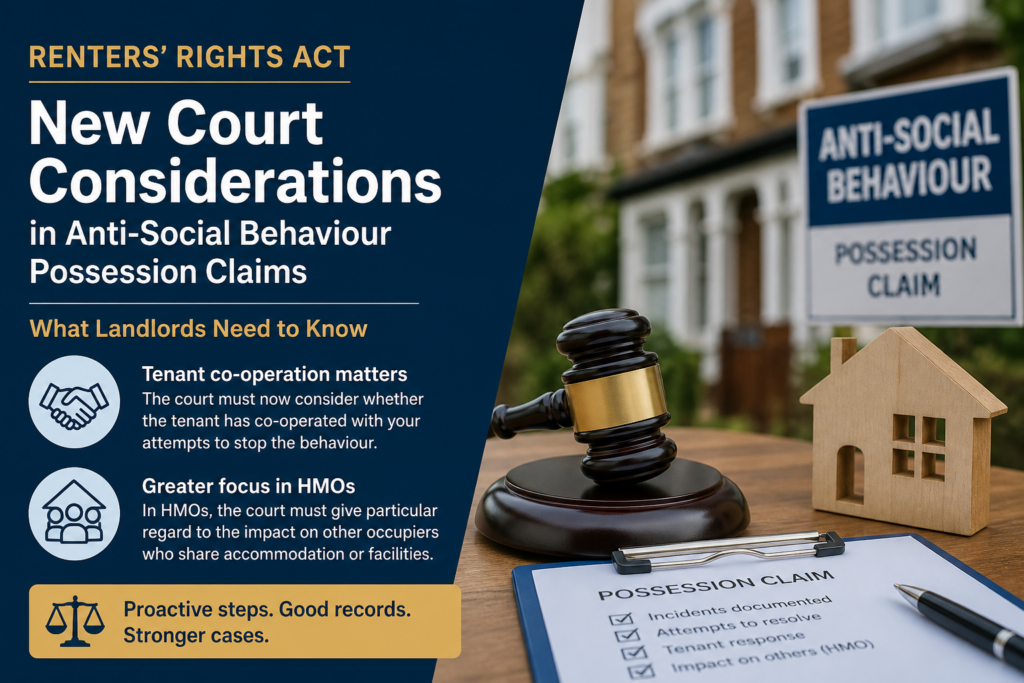
One of the most significant amendments is the introduction of a requirement for the court to consider whether the tenant has co-operated with attempts to stop the behaviour. This represents a clear shift away from a purely incident-based assessment.
In practical terms, the court will now want to understand the full story. It will consider whether the landlord made reasonable efforts to address the issue before taking legal action, and whether the tenant engaged with those efforts. For example, if a landlord raised concerns, issued warnings, or tried to resolve matters informally, this will be relevant. Equally, the tenant’s response—whether cooperative or dismissive—can significantly influence the outcome.
A tenant who ignores repeated attempts to resolve the issue or continues the behaviour despite intervention is far more likely to face possession. On the other hand, where a tenant has engaged constructively, acknowledged the problem, or taken steps to improve, the court may take a more cautious approach.
This change reflects a broader policy direction: encouraging early resolution and ensuring that possession is used as a last resort, rather than a first step.
Greater Focus on Shared Living Environments
Another key development relates to properties that are classified as Houses in Multiple Occupation (HMOs), as defined by the Housing Act 2004. In these cases, the court must now give particular attention to the impact of the behaviour on other occupiers who share accommodation or facilities.
This is a significant point for landlords who manage shared properties. The law recognises that anti-social behaviour in an HMO can have a more immediate and intense impact than in a self-contained home. Where tenants share kitchens, bathrooms, or living areas, even relatively minor issues can escalate quickly and affect the day-to-day lives of others.
The definition of “sharing” is deliberately broad. If occupiers are entitled to use common facilities under their tenancy or licence, they are considered to be sharing. This means the vast majority of HMOs will fall within this provision.
As a result, the experiences of other tenants in the property will carry more weight than before. Evidence showing how the behaviour has affected others—whether through noise, intimidation, disruption, or general discomfort—can play a crucial role in the court’s decision.
What This Means for Landlords
Taken together, these changes highlight the importance of a measured and well-documented approach to dealing with anti-social behaviour.
Landlords should be mindful that the court will expect to see more than just a record of complaints. It will want to know what steps were taken to resolve the issue and whether the tenant was given a fair opportunity to change their behaviour. At the same time, where those efforts have been ignored or unsuccessful, this can strengthen the case for possession.
In HMO settings, the focus widens further. The court will look closely at how the behaviour has affected other occupiers, particularly where shared spaces are involved. This reflects a recognition that maintaining a safe and livable environment for all tenants is a key consideration.
A More Balanced Legal Framework
The overall effect of these reforms is to create a more balanced system. Anti-social behaviour remains a serious issue, and landlords retain the ability to take action where necessary. However, the court is now required to consider not just the behaviour itself, but the steps taken to address it and the impact on others.
For landlords, the message is clear: possession claims must now tell a complete story. Demonstrating that reasonable efforts were made to resolve the issue—and that those efforts were unsuccessful—will be just as important as proving the behaviour itself.
In many cases, this will not make claims more difficult, but it will make them more structured and evidence-driven. Landlords who approach these situations carefully and proactively are likely to be in a much stronger position if the matter ultimately reaches court.