
Evictions Under the Renters’ Rights Act 2025
The Renters’ Rights Act 2025 represents one of the most significant overhauls of English housing law in decades. For landlords, understanding evictions under the Renters’ Rights Act 2025 is essential to stay compliant and protect their property rights.
The Act replaces the long-standing Section 21 “no-fault” eviction process with a fairer, regulated framework that strengthens tenants’ rights while still allowing landlords to regain possession lawfully.
The End of Section 21 and the New Legal Framework
Under the Renters’ Rights Act 2025, the familiar Section 21 “no-fault” eviction has been abolished. Landlords can no longer end tenancies simply by serving a two-month notice without cause. Instead, evictions must now proceed through specific, legally recognised grounds under the new Section 8-style process.
This reform aims to make the rental market more stable and predictable. Tenants will enjoy open-ended tenancies, while landlords retain the right to repossess properties for legitimate reasons, such as rent arrears, sale of the property, or landlord reoccupation.
Grounds for Eviction Under the New Law
The Renters’ Rights Act 2025 introduces new and updated possession grounds that align with modern rental realities. These grounds are divided into mandatory and discretionary categories:
Mandatory grounds include cases where the tenant has serious rent arrears, persistent non-payment, or significant breaches of tenancy terms.
Discretionary grounds allow courts to consider fairness, such as where the landlord needs to sell or occupy the property themselves.
Crucially, landlords must now provide detailed evidence when seeking possession. This ensures evictions under the Renters’ Rights Act 2025 are justified, transparent, and procedurally sound.
Notice Requirements and Timelines
The notice process has been restructured to provide clarity for both parties. Landlords must issue a written notice specifying the ground for possession, evidence supporting the claim, and the minimum notice period required by law.
In most cases, a four-month minimum tenancy term applies before any eviction notice can be served, except for serious breaches such as anti-social behaviour or extreme rent arrears. The new notice periods vary depending on the reason for eviction, ranging from two weeks to three months.
This approach balances landlord flexibility with tenant protection, making evictions under the Renters’ Rights Act 2025 more consistent and accountable.
The Court Process and Evidence Standards
If a tenant disputes the notice, landlords must apply for a possession order through the county court. The court will review the notice, supporting documentation, and evidence of compliance with procedural rules.
Under the Renters’ Rights Act 2025, digital submissions and remote hearings are being expanded to speed up possession claims. However, accuracy and documentary evidence remain crucial. Any errors or missing details in the notice or the filing process can delay the claim or result in its dismissal.
Landlords must also show compliance with deposit protection, property safety, and licensing obligations before the court will consider an eviction request.
Repossessing a Property for Sale or Reoccupation
A primary concern for landlords has been the ability to regain possession when they wish to sell or move back into their property. The Renters’ Rights Act 2025 addresses this through new, clearly defined grounds.
If a landlord intends to sell, they must provide proof of genuine intent, such as estate agent correspondence or listing evidence. Similarly, reoccupation grounds require the landlord (or a close family member) to demonstrate a legitimate need to reside in the property.
Evictions under the Renters’ Rights Act 2025 for these reasons will still require proper notice and cannot be used as disguised “no-fault” evictions.
Anti-Social Behaviour and Serious Rent Arrears
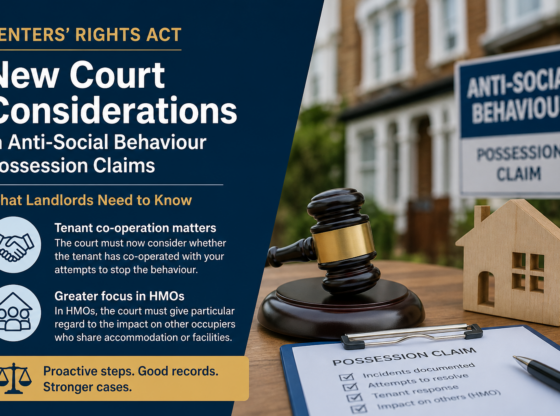
The Act introduces faster procedures for dealing with tenants engaged in anti-social behaviour or serious arrears. In such cases, landlords can issue shortened notice periods and fast-track court proceedings.
This ensures communities are protected while landlords are not left powerless against disruptive or non-paying tenants. Evictions under the Renters’ Rights Act 2025 now strike a careful balance between fairness and enforcement.
Compliance and Record-Keeping for Landlords
To succeed under the new system, landlords must maintain accurate, up-to-date records. This includes tenancy agreements, inspection reports, rent ledgers, deposit certificates, and safety certificates.
During any eviction process, these records form the backbone of a landlord’s case. Failure to comply with statutory requirements, such as energy performance or safety certification, can invalidate eviction notices entirely.
Understanding evictions under the Renters’ Rights Act 2025 means being proactive — not reactive — about compliance.
How Landlords Can Prepare for the Transition
Landlords should review all existing tenancy agreements and convert fixed-term contracts into periodic ones in line with the Act’s provisions. They should also familiarise themselves with the new notice forms, digital court procedures, and documentation standards.
Joining professional bodies such as the British Landlords Association (BLA) can provide essential guidance, updated templates, and access to expert legal support during this transition.
FAQs
What replaces Section 21 under the new law?
Section 21 is replaced with specific possession grounds under the new eviction framework. Landlords must now cite a lawful reason to end a tenancy.
Can I still evict tenants for non-payment of rent?
Yes. Persistent or severe rent arrears remain a mandatory ground for possession. However, landlords must follow the correct notice and evidence procedures.
How long does the eviction process take under the new system?
Timeframes will vary depending on the grounds, but digital court systems should make legitimate evictions under the Renters’ Rights Act 2025 faster and more predictable.
Do existing tenancies automatically convert?
Yes, fixed-term tenancies will transition to periodic arrangements, and landlords must comply with the new framework once the Act takes effect.
Conclusion
Evictions under the Renters’ Rights Act 2025 represent a significant shift in how landlords manage possession in England. While the loss of Section 21 changes the landscape, the new system offers structure, fairness, and legal clarity.
By understanding the notice process, evidence requirements, and valid grounds for possession, landlords can navigate evictions under the Renters’ Rights Act 2025 with confidence and compliance.
Staying informed and prepared is now the key to protecting property investments lawfully and efficiently.
Read our top-read blogs:
Why Landlords Are Selling Up Urgently?
The Renters Reform Bill: A Step Backwards for Landlords and the Housing Market?
Defending a Claim for Unlawful Eviction
Need help now? Contact Landlord Advice UK today for tailored guidance and practical support to future-proof your rental business.
Useful External Links
https://www.gov.uk/private-renting-evictions
https://www.gov.uk/guidance/renters-rights-act-2025