
Grounds for Possession Explained: How Evictions Work After Section 21 Is Gone
With the introduction of the Renters’ Rights Act 2025, the end of Section 21 marks the most significant change in England’s private rental market in decades.
Landlords must now rely on new grounds for possession to regain control of their property. Understanding these changes is essential for any landlord seeking to remain compliant and effective under the new legal framework.
This guide explains how grounds for possession operate under the Renters’ Rights Act 2025 and compares them to the old Section 8 system that previously governed most tenant evictions.
The End of Section 21 and the Shift to ‘Reasonable Grounds’
For many years, Section 21 allowed landlords to recover possession of their property without providing a reason. These “no-fault” evictions gave landlords flexibility but left tenants vulnerable to sudden displacement.
The Renters’ Rights Act 2025 eliminates Section 21. From now on, landlords can only evict tenants using reasonable grounds for possession, meaning valid reasons and evidence must support each eviction.
The new system aims to protect tenants from unfair evictions while still allowing landlords to act decisively when legitimate issues arise. Evictions are no longer about ease they’re about fairness, proof, and compliance.
How the New Grounds for Possession Work
Under the new framework, landlords must provide one of several reasonable grounds for possession when seeking to end a tenancy. Each ground specifies whether it is mandatory (the court must grant possession) or discretionary (the court decides based on circumstances).
Mandatory grounds include:
- Severe or persistent rent arrears: If a tenant repeatedly fails to pay rent, the court is likely to grant a possession order.
- Landlord reoccupation: When a landlord, or close family member, genuinely intends to move into the property.
- Sale of the property: When the landlord wants to sell, they can provide proof of a genuine sale process.
Discretionary grounds cover issues such as anti-social behavior, property neglect, or minor breaches of tenancy terms.
These grounds for possession under the Renters’ Rights Act 2025 mirror parts of the old Section 8 framework but with more precise definitions, improved fairness, and stricter evidential requirements.
Comparison with the Old Section 8 System
The old Section 8 system required landlords to specify one or more statutory grounds (from Grounds 1–17) when seeking possession. These included rent arrears, landlord occupation, property damage, or anti-social conduct.
While similar in concept, the new grounds for possession under the Renters’ Rights Act 2025 offer more structure and consistency. Key differences include:
- Simplified notice process: The new forms are clearer and must detail the specific reason and supporting evidence.
- Enhanced tenant protection: Courts can now weigh the reasonableness of each claim, reducing the risk of misuse.
- Digital applications: Landlords can submit eviction cases online, improving efficiency and transparency.
In short, the spirit of Section 8 lives on but with stronger checks, more precise requirements, and greater accountability.
Evidential Requirements for Landlords
The new framework demands stronger documentation. To rely on new grounds for possession, landlords must produce credible evidence that the grounds exist and justify their claim. Examples include:
- Rent statements for arrears cases.
- Sales agreements or estate agent communications for sale-related claims.
- Evidence of genuine residence needs for reoccupation cases.
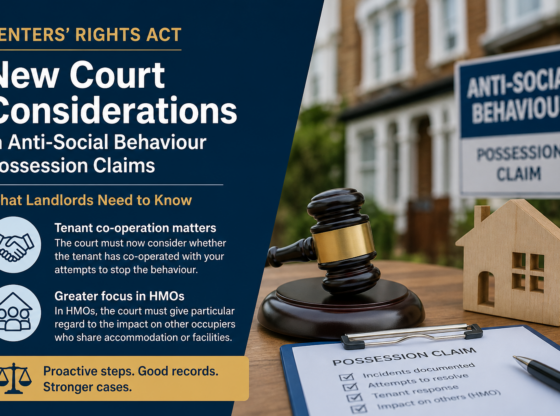
- Witness statements or police reports for anti-social behavior cases.
This evidential standard ensures that evictions are fair and fact-based. Landlords who cannot substantiate their claims will struggle to obtain possession orders.
Notice Periods and Timing
The Renters’ Rights Act 2025 introduces flexible notice periods depending on the reason for eviction.
- For serious rent arrears, landlords can give as little as two weeks’ notice.
- For sale or landlord reoccupation, three months’ notice is required.
- In cases of anti-social behavior, courts can expedite hearings in urgent situations.
This balanced approach protects responsible tenants while allowing landlords to regain their property when justified.
Court Proceedings and Enforcement
Once the notice period expires, landlords may apply for a possession order through the county court. Judges will assess whether the grounds for possession are valid and if procedural requirements were met.
Landlords who comply fully with deposit protection, licensing, and safety obligations are more likely to succeed. The new system emphasizes digital filing, meaning evidence must be clear, organized, and easily reviewable.
If the tenant fails to vacate after a court order, a bailiff or enforcement agent may be appointed to recover possession.
Practical Tips for Landlords
To adapt effectively to the post–Section 21 landscape:
- Review all tenancy agreements and ensure they are compliant with the Renters’ Rights Act 2025.
- Keep detailed written records of rent payments, communications, and property inspections.
- Serve the correct notice form and double-check deadlines.
- Use reputable legal templates and seek professional advice if unsure.
These practices will ensure the new grounds for possession system works in your favor and reduces delays or costly legal challenges.
FAQs
What replaced Section 21?
The Renters’ Rights Act 2025 replaced Section 21 with a “reasonable grounds” eviction system that requires evidence for every possession claim.
Can landlords still regain possession easily?
Landlords can still recover possession efficiently provided their claims are valid, well-documented, and compliant with the Act.
Are old Section 8 forms still valid?
No, new notice forms must be used under the Renters’ Rights Act 2025, tailored to the updated grounds and processes.
How long will eviction cases take now?
Timelines vary depending on grounds and court capacity, but digital submission and tracking aim to streamline proceedings.
Conclusion
The abolition of Section 21 has transformed the eviction landscape in England. The grounds for possession under the Renters’ Rights Act 2025 are designed to promote fairness, clarity, and evidence-based justice.
While landlords can no longer rely on automatic “no-fault” evictions, the new system still allows for lawful, efficient possession when the grounds are genuine and properly proven.
By maintaining strong records and following proper procedures, landlords can continue to protect their investments with confidence in this new era of tenancy reform.
Read our top-read blogs:
Why Landlords Are Selling Up Urgently?
The Renters Reform Bill: A Step Backwards for Landlords and the Housing Market?
Defending a Claim for Unlawful Eviction
Need help now? Contact Landlord Advice UK today for tailored guidance and practical support to future-proof your rental business.