
Renters’ Rights Act 2025: Enforcement Date
The Renters’ Rights Act 2025 represents the most significant overhaul of housing law in more than 30 years. The current system is widely acknowledged as broken, but implementing reforms of this scale all at once would risk overwhelming courts, landlords, tenants, and local authorities. To avoid disruption, the Government will introduce the Act in three carefully structured phases, giving everyone time to prepare and ensuring the reforms work smoothly from day one.
Why the Act Is Being Rolled Out in Phases
Housing law touches millions of people. Sudden implementation would create confusion, inconsistent enforcement, and administrative chaos. A phased rollout supports education, adaptation, and system updates across the private rented sector (PRS) and, later, the social sector.
Phase 1 — Starting 1 May 2026: Major PRS Reforms Begin
Phase 1 contains the headline reforms that will reshape the private rented sector. All of the following changes take effect on 1 May 2026.
1. Abolition of Section 21 ‘No Fault’ Evictions
Landlords will no longer be able to evict tenants using Section 21 of the Housing Act 1988. This marks the end of “no-fault” evictions, shifting all possession routes onto the Section 8 framework, where a landlord must justify the eviction with valid grounds.
2. Assured Periodic Tenancies Become the New Standard
Most new and existing PRS tenancies will automatically convert into Assured Periodic Tenancies (APTs). Tenants can stay as long as they wish, unless a landlord proves a statutory ground for possession. Tenants can leave at any time with two months’ notice. Fixed terms become the exception, not the norm.
3. Reformed Possession Grounds
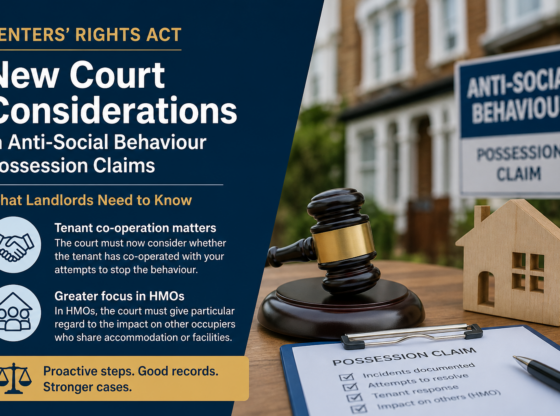
To balance the removal of Section 21, Section 8 possession grounds are strengthened. The reforms include clearer, more robust grounds for anti-social behaviour, streamlined grounds for serious and persistent rent arrears, and legitimate pathways for landlords to regain a property when genuinely necessary.
4. Rent Increases Limited to Once Per Year
Rent can only be increased annually, and only through the revised Section 13 process. Landlords must give a minimum of two months’ notice, clearly setting out the proposed new rent.
5. Ban on Rental Bidding and Limits on Rent in Advance
Landlords and agents cannot ask for, encourage, or accept offers above the advertised rent. They also cannot demand more than one month’s rent in advance. This aims to end bidding wars and financial barriers for tenants.
6. Ban on Discrimination Against Tenants With Children or Benefits
It becomes illegal to disadvantage or exclude tenants because they have children or receive benefits. This includes refusing viewings, withholding information, or declining applications for discriminatory reasons. This reform is designed to widen access to housing fairly and transparently.
7. Landlords Must Properly Consider Pet Requests
Tenants will be able to request permission to keep a pet. Landlords will have 28 days to respond and must give valid, written reasons if refusing. While not an automatic right to pets, this change introduces accountability and fairness.
8. Increased Enforcement Powers and Expanded Rent Repayment Orders
Councils gain stronger tools to enforce housing standards. Civil penalties are broadened, reporting duties introduced, and Rent Repayment Orders expanded to include superior landlords. Maximum penalties are doubled, and repeat offenders will face the highest sanctions automatically.
Council Investigatory Powers Arrive Earlier — 27 December 2025
Before Phase 1 begins, local authorities will receive enhanced investigatory powers from 27 December 2025. These include the ability to inspect properties, require documents, and access third-party data. This early rollout is aimed at tackling rogue landlords and preparing councils for the enforcement demands of 2026.
Phase 2 — Reforms Extend to the Social Rented Sector
The biggest changes—abolition of Section 21 and new tenancy structures—will not initially apply to the social rented sector. These will be brought in during Phase 2, following detailed work with social housing landlords and the Regulator of Social Housing to ensure compatibility with existing safeguarding frameworks.
What This Means for the Sector
For landlords: Expect significant procedural changes, especially regarding possession, rent reviews, and compliance.
For tenants: Security increases dramatically, alongside new rights around rent, pets, and discrimination.
For letting agents: Advertising, onboarding, and compliance processes must be redesigned.
For councils: A major uplift in enforcement responsibility and capability.
Conclusion
The Renters’ Rights Act 2025 is a fundamental reset of renting in England. With clear phased dates, stakeholders now have a roadmap for adapting well ahead of the changes. Phase 1 in May 2026 will reshape the PRS permanently, with Phase 2 extending reforms into social housing. Preparation now is not optional—it’s essential.