
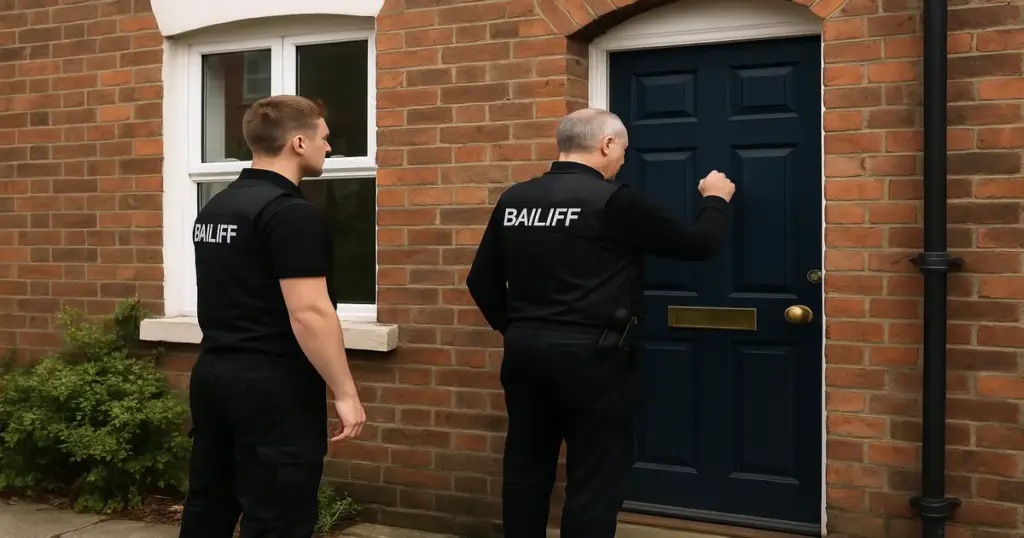
Can County Court Bailiffs Collect Debt as Well as Evict My Tenant in England
Landlords often ask whether county court bailiffs can collect debt as well as evict my tenant in England. This is an essential question because choosing the proper enforcement method can make the difference between a smooth recovery and months of delay.
County court bailiffs can perform both functions, but within specific limits and conditions that every landlord should understand.
What County Court Bailiffs Do in England
County court bailiffs are directly employed by His Majesty’s Courts and Tribunals Service (HMCTS). Their role is to enforce court orders, including possession orders and judgments for unpaid rent.
When a tenant refuses to vacate a property after a possession order has been granted, the bailiff is authorized to attend the property and evict the tenant lawfully.
If the landlord’s possession order also includes a judgment for rent arrears, county court bailiffs can collect debt as well as evict tenants in England. However, they can only recover up to £5,000 under a warrant of control, unless the debt arises under the Consumer Credit Act, which must remain in the county court.
When County Court Bailiffs Can Collect Debt and Evict Tenants
There are certain circumstances where using county court bailiffs to collect debt, as well as evict tenants in England, is appropriate. These include:
Possession Orders with Rent Arrears
When the possession order includes a money judgment for rent arrears, landlords can request the court to issue a warrant of control. The bailiff can then enforce both the eviction and the debt recovery together.
Residential Evictions
For residential landlords, county court bailiffs are often the default option. They are legally authorized to remove tenants from properties once the possession date has passed.
Low to Moderate Rent Arrears
If the total debt is below £5,000, county court bailiffs can collect debt as well as evict tenants in England effectively without needing to transfer enforcement to the High Court.
Non-Urgent Evictions
When time is not a critical factor, county court bailiffs offer a straightforward, lower-cost enforcement method, suitable for landlords willing to wait several weeks for execution.
When County Court Bailiffs Are Not the Best Option
There are also times when county court bailiffs should not be used to collect debt or evict tenants in England, especially when efficiency and speed are priorities.
Significant Rent Arrears
If arrears exceed £5,000, county court bailiffs cannot enforce collection beyond that limit. In such cases, landlords should transfer the judgment to the High Court for enforcement by High Court Enforcement Officers (HCEOs).
Urgent or High-Risk Evictions
County court bailiffs often have long backlogs, sometimes waiting several weeks before attending. Where urgent eviction is needed, or the tenant poses a security risk, HCEOs can act within days.
Commercial Tenancies
For business premises, county court bailiffs are rarely used. Commercial landlords usually prefer High Court enforcement for faster and more decisive results.
Limited Resources and Delays
Because county court bailiffs handle a high volume of cases, delays are common. This can lead to lost rental income and further property damage, making it one of the cases when county court bailiffs should not be used to collect debt, as well as evict tenants in England.
How County Court Debt Collection Works
When a landlord applies for a warrant of control to recover rent arrears, county court bailiffs can collect debt as well as evict tenants in England by visiting the property and seizing goods belonging to the tenant. These goods can then be sold to satisfy the judgment debt.
The process generally follows these steps:
- Obtain a possession order including a rent arrears judgment.
- Apply for a warrant of possession to authorize eviction.
- Apply for a warrant of control if you wish to recover money.
- The bailiff then visits the property to enforce the court orders.
While this combined process is possible, it’s slower and less efficient than High Court enforcement, which can be completed in a fraction of the time.
High Court Enforcement vs County Court Bailiffs
The main difference between county court bailiffs and High Court Enforcement Officers lies in speed, authority, and debt limits.
While county court bailiffs can collect debt as well as evict tenants in England, HCEOs act under the authority of the High Court and have greater powers.
County Court Bailiffs
- Employed by HMCTS.
- Enforce up to £5,000 debt.
- Slower scheduling times (often 4–8 weeks).
- Lower cost but limited flexibility.
High Court Enforcement Officers
- Privately appointed by the High Court.
- No limit on debt enforcement.
- Faster—can act within days.
- Additional costs but faster recovery and eviction.
If you need urgent possession, higher arrears collection, or a more assertive approach, transferring enforcement to the High Court is often the best option.
Advantages of County Court Bailiffs
When used appropriately, county court bailiffs can collect debt as well as evict tenants in England, with several benefits:
- Lower costs compared to High Court enforcement.
- A simple process is available through the county court system.
- Legal compliance ensured by HMCTS oversight.
- Sufficient for small arrears and standard residential evictions.
For landlords managing lower-value claims or standard possession orders, bailiffs remain a practical and cost-effective choice.
Limitations of County Court Bailiffs
Despite their authority, there are notable drawbacks. The biggest issue is delay. County court bailiffs often face long scheduling queues, leading to significant waiting periods before eviction takes place. Their workload and limited resources also mean they may not prioritize individual cases.
Another limitation is the financial ceiling of £5,000. If your tenant owes substantial arrears, county court bailiffs can collect debt as well as evict your tenant in England, but only up to that limit. For larger sums, High Court enforcement is the only practical route.
Best Practice for Landlords
Before deciding how to enforce your possession and debt orders:
- Assess the total arrears and determine whether it exceeds £5,000.
- Consider urgency—if time-sensitive, transfer to the High Court.
- Seek legal advice on whether dual enforcement is practical.
- Use reputable professionals to avoid delays and ensure compliance.
Making the right enforcement decision can save weeks of waiting and unnecessary expense.
FAQs
Can county court bailiffs enforce both eviction and debt recovery at once?
Yes, they can, provided a possession order and a money judgment are in place.
How long does the process take?
It typically takes 4–8 weeks from the date of application for a bailiff appointment.
What is the maximum amount county court bailiffs can collect?
They can recover up to £5,000 under a warrant of control.
Can I transfer my case to the High Court?
Yes. You can apply for permission under Section 42 of the County Courts Act 1984.
Do bailiffs need to give notice before visiting?
Yes, they must provide written notice before attending the property.
Conclusion
In summary, county court bailiffs can collect debt as well as evict my tenant in England, but their powers are limited compared to High Court Enforcement Officers. They are best suited for small rent arrears and routine residential evictions where time is not a pressing issue. For larger arrears or urgent cases, landlords should consider transferring enforcement to the High Court for faster and more effective results.
Understanding these distinctions helps landlords recover both possession and debt legally, efficiently, and without unnecessary delay.
Read our top read blogs:
Why Landlords Are Selling Up Urgently?
The Renters Reform Bill: A Step Backwards for Landlords and the Housing Market?
Defending a Claim for Unlawful Eviction
Need help now? Contact Landlord Advice UK today for tailored guidance and practical support to future-proof your rental business.
Useful External Links
https://www.gov.uk/county-court-bailiff
https://www.gov.uk/evicting-tenants